Certified Automotive Penetration Testing Professional

Certified Automotive Penetration Testing Professional

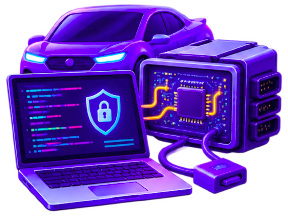
The Certified Automotive Penetration Testing Professional course provides advanced knowledge and practical methodologies for conducting authorized security assessments of modern automotive systems. You will develop a deeper understanding of vehicle architectures, ECUs, CAN bus, automotive communication networks, connected vehicle technologies, attack surfaces, and cybersecurity vulnerabilities. The course focuses on applying professional penetration-testing methodologies to identify security weaknesses, analyze potential attack paths, assess risks, and support effective remediation in controlled environments.

₹ 59,999

Lifetime Access
OT/SCADA Hacking Course

Why Enroll in This Course?

High Demand for Skills

IoT security skills are in high demand as connected devices grow across industries.

Comprehensive Training

Gain in-depth knowledge and hands-on experience in IoT hacking and security.

Career Advancement

Enhance your career prospects by adding IoT security expertise to your skill set.

Expert Instruction

Learn from industry experts with real-world experience in IoT security and research.

Certified Automotive Penetration Testing Professional

Secure Your Future in Certified Automotive Penetration Testing Professional

Join thousands of professionals who trust UnoAcademy to build job-ready skills.
Start your journey in Certified Automotive Penetration Testing Professional today!

Enroll Now

COURSE OVERVIEW

What You'll Learn

A practical and hands-on curriculum designed to take you from the basics
to advanced CAPTP concepts and real-world investigation skills.

Practical Learning.
Real-World Skills.

Gain hands-on experience with industry-
relevant tools and techniques to become
confident in real-world CAPTP investigations

Enroll Now
OSINT Course Overview
Introduction of Vehicle

Module 1 — Introduction of Vehicle

Vehicle Architecture Overview

Detailed examination of modern vehicle architectures, including the integration of Electronic Control Units (ECUs), sensors, actuators, and communication buses. Understand how these components work together within modern vehicle systems.

Vehicle Network and Attacks

Module 2-A — Vehicle Network and Attacks

Briefing ECU

Explanation of different Electronic Control Units (ECUs) and their roles within vehicle systems.

Briefing of Vehicle Protocols

Overview of vehicle communication protocols, their uses, vulnerabilities, and potential attack surfaces.

Understanding and Briefing CANBUS Protocol

In-depth study of CANBUS message formats, communication modes, and error-handling mechanisms.

Briefing of CANBUS Frame

Detailed breakdown of CANBUS frame structures, including identifiers, data fields, and other components.

CANBUS Tools and Analysis

Module 2-B — CANBUS Tools and Analysis

Briefing of Car Hacking Tools

Introduction to tools and equipment used to analyze vehicle networks and CANBUS communications.

Eavesdropping of CANBUS Messages

Techniques for passively monitoring CANBUS messages to understand traffic and identify potential attack vectors.

Reverse Engineering of CANBUS

Methods for analyzing CANBUS communications to identify arbitration IDs and understand their corresponding events.

Attacks on Cluster

Study of instrument-cluster security weaknesses and how manipulated CANBUS traffic may affect displays and controls.

CANBUS Attack Techniques

Module 2-C — CANBUS Attack Techniques

Replay Attacks

Understand replay attacks on CAN networks, their potential impact, and defensive measures.

Sending Forged CANBUS Messages

Explore forged CAN messages, the security risks they create, and how validation can help reduce these risks.

DoS Attack on CANBUS Network

Study denial-of-service attacks that can disrupt CAN network availability and vehicle operations.

CANBUS Fuzzing

Learn how fuzz testing can reveal protocol-handling flaws and vulnerabilities in controlled test environments.

CANBUS Error and Disruption Attacks

Module 2-D — CANBUS Error and Disruption Attacks

Bus-Off Attack

Understand CAN bus-off conditions, how communication may be disrupted, and methods for detection and prevention.

Error Passive Spoof Attack

Explore CAN error states and how manipulated error conditions can affect communication reliability.

Freeze/Doom Loop Attack

Study how malformed or repeated CAN traffic may affect ECU responsiveness and system stability.

Bypass Gateways with Janus Attack

Learn about gateway security weaknesses and the importance of protecting communication between vehicle network segments.

UDS and ECU Diagnostic Security

Module 2-E — UDS and ECU Diagnostic Security

Introduction to Seed and Key Bypass

Overview of Seed and Key security mechanisms used in vehicle ECUs and the weaknesses that authorized assessments may examine.

Briefing of UDS

Learn about Unified Diagnostic Services (UDS) and its role in vehicle diagnostics, maintenance, and ECU communication.

Enumeration of Supported Diagnostic Services

Understand how supported UDS diagnostic services can be identified during authorized vehicle security assessments.

ECU Reset Service Attack

Study security risks associated with the UDS ECU Reset service and how diagnostic access should be protected.

Dynamic Data Identifiers

Module 2-F — Dynamic Data Identifiers

Enumeration of Dynamic Data Identifiers

Methods for identifying Dynamic Data Identifiers (DDIs) in UDS and understanding how access controls help prevent unauthorized data access or manipulation.

Diagnostic Security Considerations

Understand why diagnostic services, ECU reset functions, and data identifiers require appropriate authorization and security controls.

Infotainment Bluetooth Security

Module 3-A — Infotainment (IVI)

Bluetooth Classic/BLE

Introduction to Bluetooth Classic and Bluetooth Low Energy (BLE) and their applications in vehicle infotainment systems.

Reconnaissance with HCI Tools

Active and passive reconnaissance using Host Controller Interface (HCI) tools to gather information about Bluetooth devices.

Attacks over RFCOMM

Study potential security weaknesses in Bluetooth RFCOMM communication channels and their impact on connected devices.

L2CAP Smashing

Understand L2CAP security and how testing can reveal weaknesses in Bluetooth communication implementations.

GATT Protocol Security

Module 3-B — GATT Protocol Security

GATT Service Enumeration

Enumeration of Generic Attribute (GATT) services exposed by Bluetooth-enabled vehicle devices.

Sniffing and Reversing GATT Protocol Communication

Methods for capturing and analyzing GATT communications to understand device interactions and identify security concerns.

Read and Write Attacks on GATT Protocol

Understand risks associated with unauthorized reads and writes to GATT characteristics and how permissions protect device behavior.

Fuzzing GATT Protocols

Application of fuzz testing techniques to identify protocol-handling errors and vulnerabilities in GATT implementations.

USB Security

Module 4 — USB

Fuzzing on USB Stack

Application of fuzz testing techniques to identify input-handling flaws and vulnerabilities in vehicle USB implementations.

USB Interception and Attacks on Specific Classes

Techniques for examining USB communications, understanding device-class risks, and identifying weaknesses in vehicle USB interfaces.

MOST Protocol

Module 5 — Introduction of MOST Protocol

Introduction to MOST Protocol

Overview of Media Oriented Systems Transport (MOST), a communication protocol used in automotive multimedia and infotainment systems.

Fleet Management System

Module 6 — Fleet Management System

GPS Attacks

Explore GPS security risks, including misleading positioning information, vehicle tracking concerns, and GPS spoofing. Learn about detection and mitigation approaches for protecting fleet operations.

Key Fob Fundamentals

Module 7-A — Key Fobs

Introduction

Overview of key fobs and their role in vehicle access, remote locking, unlocking, and security.

Reconnaissance of Key Fob Frequencies

Techniques for identifying and analyzing frequencies used by vehicle key fobs in an authorized test environment.

Reverse Engineering of Key Fob Data

Methods for examining and analyzing key fob signals and transmitted data to understand communication behavior.

Sending Malformed Key Fob Requests

Understand how malformed inputs can be used in controlled testing to assess the robustness of key fob systems.

Key Fob Attack and Defense

Module 7-B — Key Fob Attacks and Security

Jamming at RX and TX

Understand radio-frequency interference risks affecting key fob reception and transmission, along with detection and mitigation methods.

Defeating Encoding Mechanisms

Study encoding and cryptographic protections in key fobs and how security assessments identify weaknesses in their implementation.

Replay Attack on Key Fob

Understand replay attack concepts, captured-signal risks, and how rolling codes and challenge-response mechanisms help prevent misuse.

Attack on Key Fob

Explore common key fob security weaknesses and defensive measures that help prevent unauthorized vehicle access.

Automotive Hardware

Module 8 — Hardware

Basics of Electronics

Fundamentals of electronic components and circuits and their relevance to automotive systems.

Understanding Electronic Components

Detailed explanation of common electronic components used in vehicle systems and their functions.

PCB Reverse Engineering and Component Identification

Techniques for examining printed circuit boards (PCBs) to identify components, understand connections, and analyze hardware architecture.

I2C Protocol

Module 9 — I2C

Introduction to I2C

Overview of the Inter-Integrated Circuit (I2C) protocol and its applications in automotive systems.

I2C Protocol

Detailed explanation of I2C addressing, data transfer modes, signaling, and communication rules.

Interfacing with I2C

Techniques for interfacing with I2C devices and examining data exchange in automotive applications.

Sniffing Run-time I2C Communication

Methods for monitoring and analyzing real-time I2C communication between devices in vehicle systems.

SPI Protocol

Module 10 — SPI

Introduction to SPI

Overview of the Serial Peripheral Interface (SPI) protocol and its use in automotive electronics.

SPI Protocol

Detailed breakdown of SPI data transfer modes, clock signals, and communication rules.

Interfacing with SPI

Techniques for interfacing with SPI devices and examining data exchange in automotive systems.

Sniffing Run-time SPI Communication

Methods for capturing and analyzing real-time SPI communication between electronic components.

UART Identification

Module 11-A — UART

Introduction to UART

Overview of the Universal Asynchronous Receiver-Transmitter (UART) protocol and its role in vehicle communication.

Identifying UART

Techniques for identifying UART interfaces in vehicle systems and understanding their common characteristics.

Automated Identification

Automated methods and tools for detecting potential UART interfaces in automotive environments.

Manual Identification

Manual techniques for locating and identifying UART interfaces on vehicle hardware.

UART Debugging

Module 11-B — UART Debugging

Debugging Over UART

Methods for using UART interfaces to debug and interact with vehicle ECUs and electronic systems in authorized test environments.

UART Security Considerations

Understand why exposed debug interfaces need appropriate access controls to protect vehicle firmware, data, and system functionality.

JTAG and SWD Identification

Module 12-A — JTAG/SWD

Introduction to JTAG/SWD

Overview of Joint Test Action Group (JTAG) and Serial Wire Debug (SWD) interfaces in vehicle electronics.

Identifying JTAG/SWD

Techniques for identifying and locating JTAG/SWD interfaces on vehicle hardware.

Automated Identification

Automated tools and methods for detecting potential JTAG/SWD interfaces in automotive systems.

Manual Identification

Manual techniques for locating and examining JTAG/SWD interfaces on vehicle electronics.

JTAG and SWD Debugging

Module 12-B — JTAG/SWD Debugging

Debugging Over JTAG/SWD

Methods for using JTAG/SWD interfaces to debug vehicle ECUs and examine memory and data access in authorized test environments.

Dumping Data and Manipulating Memory

Explore firmware extraction and memory inspection concepts, including the security implications of unauthorized debug access.

Debug Interface Security

Understand how debug access controls help protect ECU firmware, sensitive data, and critical memory regions.

Firmware Reversing

Module 13 — Firmware Reversing

Identifying Compression and Types

Methods for identifying firmware image formats, recognizing compression types, and examining firmware packages used in automotive ECUs and devices.

Firmware Analysis

Techniques for analyzing firmware functionality, understanding its behavior, and identifying potential security weaknesses.

Simulating Firmware

Simulation techniques for testing, analyzing, and validating vehicle firmware behavior in controlled environments.

How This Course
Benefits You

Student learning IoT security online

Advanced Automotive & Vehicle Security Knowledge

Develop in-depth knowledge of vehicle architectures, ECUs, CAN bus, automotive networks, connected vehicles, and automotive cybersecurity challenges.

Automotive Penetration Testing Methodologies

Learn structured approaches for reconnaissance, attack-surface identification, vulnerability assessment, and controlled security testing of automotive systems.

Practical Security Assessments

Develop skills in automotive network analysis, vulnerability identification, risk assessment, security validation, penetration testing, and professional security reporting.

Industry-Ready Automotive Pentesting Skills

Build professional expertise for careers in automotive penetration testing, vehicle cybersecurity, ECU security, CAN bus security, embedded security, vulnerability research, and automotive security consulting.

Ready to Start Your
Cybersecurity Journey?

Whether you're just beginning or advancing your expertise, UnoAcademy provides the practical cybersecurity training, hands-on experience and expert guidance you need to succeed.

Student learning cybersecurity online