

Certified IoT Penetration Testing Foundation

Certified IoT Penetration Testing Foundation

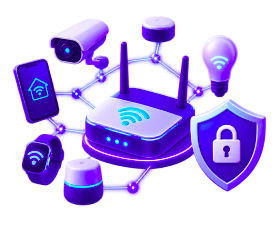
The Certified IoT Penetration Testing Foundation course provides a strong foundation in penetration testing and security assessment for Internet of Things (IoT) devices and connected systems. You will learn about IoT architectures, embedded devices, communication protocols, APIs, wireless technologies, cloud connectivity, and common IoT security vulnerabilities. The course introduces structured penetration-testing methodologies for identifying attack surfaces, assessing vulnerabilities, and evaluating the security of connected devices in controlled and authorized environments.

₹ 39,999

Lifetime Access
OT/SCADA Hacking Course

Why Enroll in This Course?

High Demand for Skills

IoT security skills are in high demand as connected devices grow across industries.

Comprehensive Training

Gain in-depth knowledge and hands-on experience in IoT hacking and security.

Career Advancement

Enhance your career prospects by adding IoT security expertise to your skill set.

Expert Instruction

Learn from industry experts with real-world experience in IoT security and research.

Certified IoT Penetration Testing Foundation

Secure Your Future in Certified IoT Penetration Testing Foundation

Join thousands of professionals who trust UnoAcademy to build job-ready skills.
Start your journey in Certified IoT Penetration Testing Foundation today!

Enroll Now

COURSE OVERVIEW

What You'll Learn

A practical and hands-on curriculum designed to take you from the basics
to advanced CIoTPTF concepts and real-world investigation skills.

Practical Learning.
Real-World Skills.

Gain hands-on experience with industry-
relevant tools and techniques to become
confident in real-world CIoTPTF investigations

Enroll Now
OSINT Course Overview
IoT Curriculum

Module 1 — Introduction to IoT

1.1 Briefing of IIoT and Usage

Explore IoT vs. IIoT, including their differences, similarities, and applications. Understand real-world examples such as smart factories, smart grids, and connected healthcare systems.

1.2 Architecture

Understand IoT ecosystem components, including sensors, actuators, gateways, and cloud services. Explore wired and wireless communication protocols and data flow from collection to processing and decision-making.

1.3 Framework/Platforms

Explore common IoT platforms such as AWS IoT, Google Cloud IoT, and Microsoft Azure IoT. Understand device management, data analytics, and platform security features.

1.4 Attack Surfaces

Identify device-level vulnerabilities such as firmware and physical access risks, network-level weaknesses involving protocols and unsecured communication, and application-level vulnerabilities in web interfaces and APIs.

1.5 OWASP IoT Top 10 Vulnerabilities

Understand the OWASP IoT Top 10 vulnerabilities, their potential impact, and real-world examples and case studies highlighting security incidents and lessons learned.

Module 3 — CoAP

3.1 Introduction

Understand the Constrained Application Protocol (CoAP), including its history, use cases, RESTful API architecture, and applications in constrained devices and environments.

3.2 Protocol Details

Explore CoAP message structures, including CON, NON, ACK, and RST, along with request/response communication and confirmable messages.

3.3 Recon and Enumeration

Learn about tools and techniques using coap-client and Copper (Cu) Firefox plugin. Understand endpoint discovery and resource URI identification.

3.4 CoAP Proxy Attacks

Understand proxy-related attack vectors, including traffic redirection and interception. Explore mitigation strategies such as secure proxy configurations and encryption.

Module 5 — Bluetooth Low Energy (BLE)

5.1 Introduction and Protocol Overview

Explore Bluetooth Low Energy (BLE) and its applications in wearables and healthcare. Understand core concepts such as GATT, GAP, and advertising packets.

5.2 Reconnaissance (Active and Passive) with HCI Tools

Learn about tools and techniques using hciconfig, hcitool, and BLE scanners. Understand device and service identification through active scanning and passive sniffing.

5.3 GATT Service Enumeration

Explore tools such as gatttool and nRF Connect to identify GATT services and characteristics, including attribute reading and writing.

5.4 Sniffing GATT Protocol Communication

Understand GATT traffic capture and analysis. Explore encryption and secure pairing as important mitigation strategies.

5.5 Reversing GATT Protocol Communication

Learn how to analyze captured traffic to understand service interactions using tools such as Wireshark and custom scripts.

5.6 Read and Writing on GATT Protocol

Understand direct access to GATT attributes and their read/write operations using tools such as gatttool and nRF Connect.

5.7 Cracking Encryption

Study security risks associated with weak Bluetooth pairing mechanisms. Explore secure pairing modes and key exchange protocols as mitigation strategies.

Module 7 — Firmware Reversing

7.1 Identifying Compression and Types

Learn common firmware compression methods such as LZMA, gzip, and bzip2. Understand identification techniques using file signatures and magic numbers.

7.2 Firmware Analysis

Explore tools and techniques using Binwalk and Firmware-Mod-Kit. Understand firmware extraction and analysis, including file systems, binaries, and configurations.

7.3 Simulating Firmware

Understand firmware emulation in controlled environments using tools such as QEMU and Ghidra to analyze and test firmware behavior.

Module 2 — MQTT

2.1 Introduction

Learn what MQTT is, including its history, use cases, and core concepts such as topics, brokers, clients, and Quality of Service (QoS) levels.

2.2 Protocol Details

Understand MQTT message structures such as CONNECT, PUBLISH, and SUBSCRIBE, along with the communication flow from connection establishment to message exchange.

2.3 Recon and Enumeration of Topics

Explore tools and techniques using MQTT Explorer and MQTT.fx. Learn topic identification, subscription methods, and topic hierarchy analysis.

2.4 DoS Attack

Understand MQTT Denial-of-Service attack vectors, including flooding and malformed packets. Explore mitigation strategies such as rate limiting, authentication, and authorization.

Module 4 — Zigbee (802.15.4)

4.1 Introduction and Protocol Overview

Learn about Zigbee and its applications in home automation and industrial control. Understand mesh networking and low-power communication concepts.

4.2 Reconnaissance

Explore tools and techniques using the KillerBee framework and ZbFind. Understand device and network identification through network scanning and endpoint discovery.

4.3 Sniffing and Eavesdropping

Understand Zigbee traffic capture and analysis using sniffers. Explore security measures such as encryption and secure key management.

4.4 Replay Attacks

Study the security risks of capturing and replaying legitimate Zigbee packets. Understand mitigation strategies using nonces and sequence numbers.

4.5 Packet Forging Attack

Understand malicious packet creation and injection risks in Zigbee networks. Explore message integrity checks as a mitigation strategy.

4.6 Jamming Attacks

Learn how interference can disrupt Zigbee communication and explore mitigation techniques such as frequency hopping and signal detection.

4.7 Dissociation Attacks

Understand how forcing devices to leave a network can affect connectivity. Explore network rejoining mechanisms as a mitigation strategy.

Module 6 — SUB-GHz RF

6.1 Introduction

Understand Sub-GHz Radio Frequency (RF) communication and its applications in remote controls and industrial environments. Explore frequency bands and modulation techniques.

6.2 Reconnaissance

Explore tools such as RTL-SDR and HackRF for identifying devices and signals through frequency scanning and signal decoding.

6.3 Overview of Various Shift Keying

Understand different modulation types, including Amplitude Shift Keying (ASK), Frequency Shift Keying (FSK), and Phase Shift Keying (PSK), with real-world IoT applications.

6.4 Reversing of RF

Learn techniques for analyzing and decoding RF signals using tools such as GNU Radio and Universal Radio Hacker.

6.5 Crafting RF Signals

Understand custom RF signal generation concepts and explore tools such as signal generators and software-defined radios.

Module 8 — ARM

8.1 Architecture

Explore ARM architecture and its applications in IoT. Understand core components such as registers, memory management, and instruction sets.

8.2 Instruction Set

Learn common ARM instructions, including data processing and control flow, along with assembly language examples.

8.3 Procedure Call Convention

Understand function calling conventions, return value handling, register usage, and stack frame management.

How This Course
Benefits You

Student learning IoT security online

IoT & Embedded Security Knowledge

Understand IoT architectures, connected devices, embedded systems, communication protocols, wireless technologies, and IoT security challenges.

IoT Penetration Testing Methodologies

Learn structured approaches for reconnaissance, attack-surface identification, vulnerability assessment, and controlled security testing of IoT environments.

Practical Security Assessment

Develop skills in IoT device analysis, network assessment, API security testing, vulnerability identification, and security validation.

Industry-Ready IoT Security Skills

Build a strong foundation for careers in IoT penetration testing, IoT cybersecurity, embedded security, device security, vulnerability research, and connected-device security.

Ready to Start Your
Cybersecurity Journey?

Whether you're just beginning or advancing your expertise, UnoAcademy provides the practical cybersecurity training, hands-on experience and expert guidance you need to succeed.

Student learning cybersecurity online